
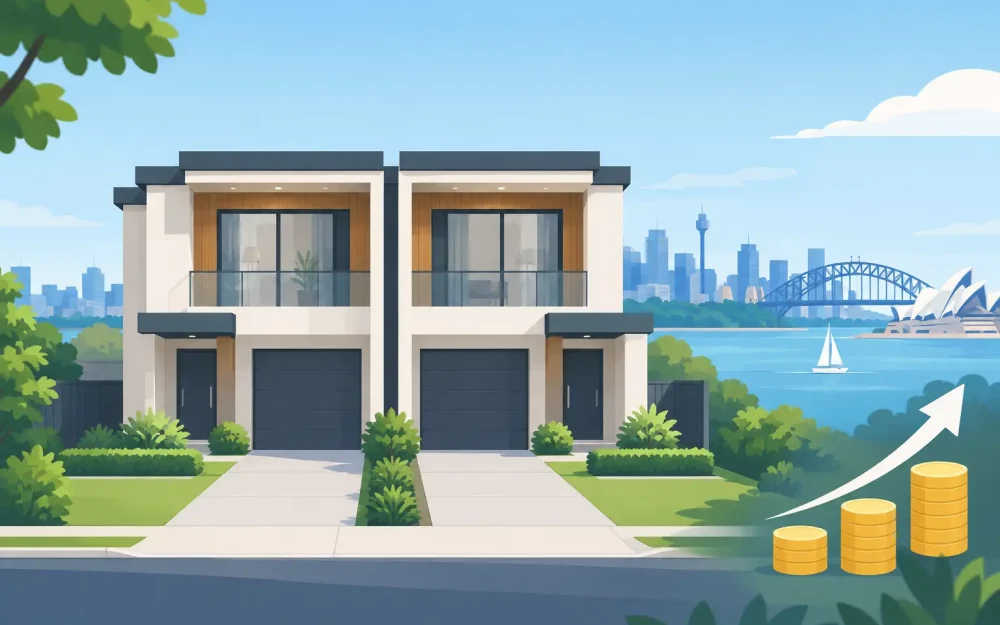
A property that can produce income from two homes rather than one has obvious appeal. For buyers comparing options across the Nambucca Valley and Mid North Coast, the question is not simply whether there are two front doors. Are dual townhouses a good investment when the purchase price, approval status, rental demand, ongoing costs and future buyer pool are all considered together?
They can be. A well-located dual townhouse can provide two rental streams, flexibility for extended family or a home-and-income arrangement, and potentially broader resale appeal. But the numbers need to work without relying on optimistic rents or future price growth. The ownership structure also matters greatly: two attached townhouses on separate titles are a different proposition from a dual occupancy on one title, or a property with an unapproved second dwelling.
Why dual townhouses attract investors
The main advantage is income diversity. With two dwellings, a vacancy in one townhouse does not necessarily leave the whole property without rent. That can make holding costs easier to manage than a single dwelling with the same total value, particularly where there is steady demand from local workers, families, retirees and lifestyle renters.
Dual townhouses may also suit a wider range of buyers when it comes time to sell. An investor may see two income streams, while an owner-occupier may see room for adult children, ageing parents, guests or a tenant next door. In markets where buyers are balancing lifestyle with affordability, this flexibility can be valuable.
Separate titles are often the strongest version of this model. Each townhouse can potentially be sold independently, subject to the relevant planning, legal and lending requirements. That gives an owner more choices later: retain both, sell one to reduce debt, or sell the pair as an investment holding. It does not guarantee a higher return, but it can improve exit options.
Are dual townhouses a good investment for your plan?
The answer depends on what you need the property to do. A buyer focused on reliable cash flow may accept a more modest location if tenant demand, achievable rent and maintenance costs are clear. A buyer seeking long-term capital growth may put more weight on land component, street appeal, proximity to shops and services, and the likely owner-occupier appeal of each townhouse.
For a local owner planning to occupy one side, the calculation is different again. Rent from the second townhouse can help with repayments, but it should be treated as income that may occasionally pause between tenancies. Allow for management fees, repairs, insurance, rates and periods when a tenant changes over. A conservative budget is much more useful than one built around the highest advertised rent in the area.
The purchase price is critical. Two smaller townhouses are not automatically better value than one freestanding home. Compare the combined price with similar rental alternatives, then look beyond headline yield. A property with a slightly lower yield but good construction, low shared costs and enduring buyer appeal may prove easier to hold and resell than a cheaper, high-yielding property with compromises.
Start with the legal and ownership structure
Before making an offer, establish exactly what is being sold. The term ‘dual townhouse’ can describe several arrangements, and each has different implications for finance, insurance, expenses and resale.
With separate Torrens titles, each dwelling generally has its own title and can often be dealt with separately. A strata arrangement may involve common property, levies, by-laws and an owners corporation. A dual occupancy on one title can still be a sound investment, but you may need to sell both dwellings together and lending options can be more limited for some purchasers.
Do not assume that a kitchenette, bathroom and separate entry make a second dwelling lawful. Ask to see approvals, plans and certificates relevant to the property. In NSW, compliance can affect insurance, tenant safety, valuation and a future buyer’s ability to obtain finance. If there are shared driveways, services or access points, clarify who is responsible for upkeep and whether formal agreements are in place.
A thorough review of the contract, title documents, strata records where relevant, council approvals and tenancy information is time well spent. Your solicitor or conveyancer, lender and building inspector each look at a different part of the picture.
Calculate the income with room for reality
A dual townhouse should be assessed as a business decision as well as a property purchase. Begin with current rent if both are leased, then compare it with evidence from genuinely comparable local rentals. If one dwelling is vacant, do not simply double the rent of the occupied side. Differences in size, parking, outdoor space, condition and privacy can change what tenants will pay.
From gross rental income, subtract the expenses that will remain even when the property is vacant. These may include council rates, water charges where applicable, landlord insurance, property management, strata levies, pest control, gardening, repairs and allowance for larger future works. Older buildings may also need a more generous maintenance provision for roofs, drainage, hot-water systems, paintwork and appliances.
Vacancy is part of the calculation, not a failure of it. A small allowance for vacancy and reletting costs creates a more realistic net return. It also helps you judge whether the investment still works if interest rates rise or a repair arrives at an inconvenient time.
If the townhouses are in a strata scheme, read the financial statements rather than relying only on the quarterly levy figure. Low levies can be positive, but they can also mean insufficient money has been set aside for future maintenance. Look for planned works, special levies, insurance arrangements and any disputes recorded in meeting minutes.
Location and liveability still drive demand
Two dwellings do not compensate for a weak location. On the Mid North Coast, rental and resale demand can be shaped by access to employment, schools, medical services, shops, beaches, river areas and transport connections. A townhouse close to Macksville services, Nambucca Heads amenities or a practical route between townships may appeal to renters who value convenience as much as outlook.
Look closely at the things tenants experience every day. Off-street parking, separate outdoor areas, storage, air flow, natural light and privacy between the two dwellings can influence both rent and tenant retention. A shared wall is expected in a townhouse, but poor acoustic separation or windows facing directly into a neighbour’s living area can limit appeal.
Flood and stormwater exposure deserve careful attention in coastal and river-connected areas. Request the appropriate planning and hazard information, inspect drainage and consider insurance availability and premiums. A well-priced property may not be a bargain if recurring risk narrows the tenant or buyer pool.
Consider the resale market before you buy
An investment is easier to manage when it has more than one plausible exit. Ask who is most likely to buy the property in five or ten years. Will it mainly appeal to investors seeking yield, or will owner-occupiers also see value in the layout? Properties with clean presentation, sensible floor plans and genuine separation between dwellings generally have a broader market.
Separate titles can be attractive, but they do not remove the need for each townhouse to stand on its own merits. Check whether each side has usable parking, an appealing entry, functional living areas and enough privacy to be marketed independently. If one side is clearly inferior, the combined income may look balanced while future saleability is not.
Be cautious about paying a premium solely for projected development potential. Planning controls, servicing, construction costs and market conditions can change. Value the property for what is approved and usable now, then treat any additional potential as an upside rather than the reason the deal must work.
When a dual townhouse may not be the right choice
A dual townhouse can be less suitable if the purchase stretches your budget so far that normal vacancies and repairs become stressful. It may also be a poor fit where there is an unclear approval history, significant deferred maintenance, restrictive strata issues or limited local demand for the rental type.
Investors should also think about management complexity. Two tenancies mean more communication, inspections, maintenance requests and lease renewals. Professional property management can reduce the workload, but it is still an expense that belongs in the numbers. For some buyers, a single, low-maintenance dwelling is the better match for their time and risk tolerance.
A dual townhouse is most compelling when it offers real separation, lawful and well-understood ownership arrangements, sustainable rental demand and a price supported by comparable sales. The best next step is to assess the individual property in its local context, with clear rental evidence and an honest view of costs. A detailed local appraisal from Vance Estate Agents can help put those figures alongside current buyer demand before you commit.